
ASC working capital planning for surgical center payment changes and reimbursement timing.
ASC working capital is still needed when CMS proposes payment increases because reimbursement potential and cash availability are not the same thing. Higher ASC payment rates and ASC Covered Procedures List expansion may create more revenue opportunity, but higher-acuity case growth can also require larger upfront cash outlays before reimbursement is collected.

Why ASCs May Still Need Working Capital After a Proposed Payment Increase
CMS proposed a 2.4% update factor to ASC payment rates for CY 2027 for ASCs meeting relevant quality reporting requirements. CMS also issued the CY 2027 OPPS/ASC proposed rule to update Medicare payment policies and rates for hospital outpatient and ASC services.
That proposed rate update does not eliminate the timing gap between when an ASC pays for a case and when cash is collected.
A proposed ASC payment increase is a reimbursement-rate event.
ASC working capital is a cash-timing tool.
A higher payment rate may improve eventual revenue, but the ASC still has to pay for supplies, implants, payroll, vendor costs, anesthesia coordination, and operating expenses before reimbursement is posted.
This becomes more important when an ASC expands into higher-acuity procedures.
The CMS Regulatory Paradox: Higher Payment Potential Can Increase Cash Needs
CMS’s CY 2027 proposal is not only about a payment update.
It is also part of a broader outpatient migration story.
CMS states that the CY 2027 OPPS/ASC proposed rule would update Medicare payment policies and rates for hospital outpatient and ASC services. CMS also notes that comments on the proposed rule are due by August 31, 2026, which means the policy is proposed, not final.
The ASC opportunity may expand because CMS and industry analyses describe major movement in the ASC Covered Procedures List and the Inpatient Only list.
ASCA reports that CMS proposed adding 618 codes to the ASC Covered Procedures List for 2027 and proposed removing 637 procedures from the Inpatient Only list.
That matters because a broader procedure list may encourage some ASCs to evaluate higher-acuity or more complex cases.
Higher-acuity cases can require more cash before the first claim is paid.
- Specialized implants
- Custom hardware
- Higher-cost disposables
- More clinical labor
- Longer room time
- Anesthesia coordination
- Vendor deposits
- Sterile processing costs
- Billing follow-up
- Denial management
The paradox is straightforward.
The payment opportunity may rise.
The upfront cost may rise first.
A proposed reimbursement increase does not fund the supplies, implants, staff, or operating costs needed on the day of service.
A 2.4% Average Update Does Not Mean Every ASC Procedure Increases
The proposed average ASC payment update should not be read as a blanket increase for every common ASC procedure.
ASCA’s analysis of the 2027 proposed payment rule states that all of the top 10 ASC codes by volume are projected to see reimbursement decreases from 2026 rates under the proposal. Those examples include common ophthalmology, gastroenterology, and pain management procedures.
This is important for liquidity planning.
Many ASCs fund growth from the cash generated by routine procedure volume.
If high-volume baseline procedures are projected to decline while higher-acuity procedures require more upfront cash, the ASC may face pressure from both sides.
The center may have more growth opportunity.
It may also have less baseline liquidity to fund that growth internally.
Medicare Payment Timing Is Not the Same as Total Cash Conversion
It would be inaccurate to say Medicare always takes 60 to 90 days to reimburse an ASC.
Medicare clean electronic claims may pay faster. First Coast Service Options explains that Medicare’s payment floor is a waiting period during which a contractor may not finalize payment on a clean claim. The waiting period is 13 days for electronic claims and 28 days for paper claims, with payment not issued until day 14 for electronic claims or day 29 for paper claims.
But ASC cash conversion is not limited to the Medicare clean-claim payment floor.
A real ASC cash cycle may include commercial payer timing, prior authorization, claim edits, denials, appeals, patient responsibility, secondary billing, and payer-mix differences.
That is why a 60- to 90-day cash conversion scenario is useful for stress-testing.
It should not be presented as a universal Medicare rule.
Planning Note
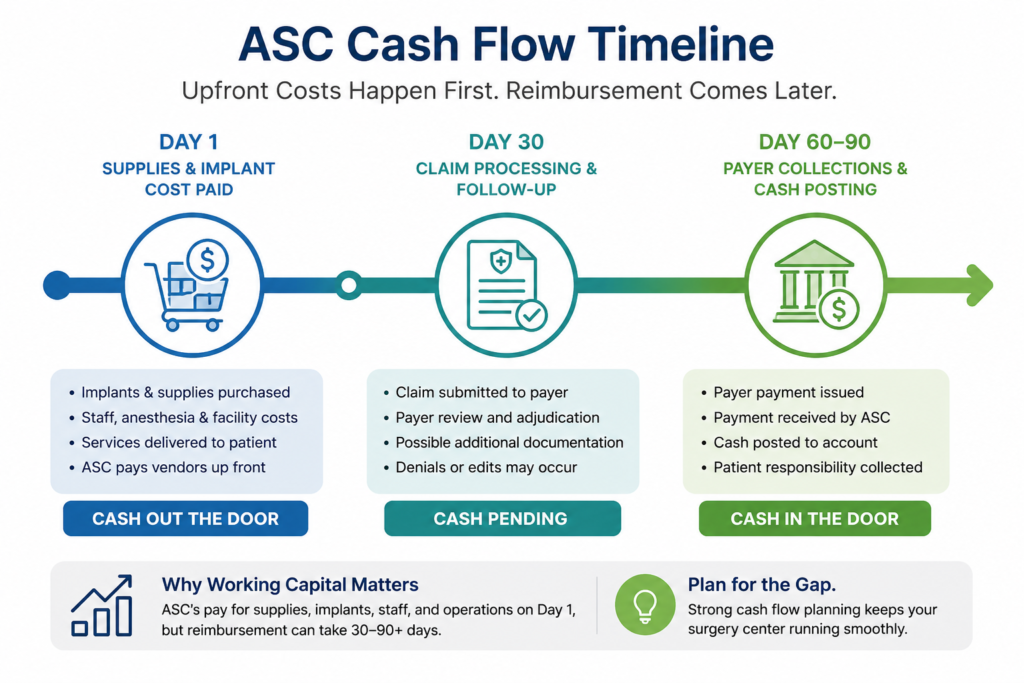
The Math: How Higher-Acuity Case Growth Creates an ASC Working Capital Gap
An ASC case-mix deficit is the cash gap created when upfront case costs are paid before reimbursement is collected.
Use this formula:
Monthly Case-Mix Cash Deficit =
New Monthly High-Acuity Cases × Upfront Cash Cost Per Case
Use this formula for a 60-day cash runway stress test:
60-Day Cash Runway Deficit =
Monthly Case-Mix Cash Deficit × 2
Use this formula for a 90-day cash runway stress test:
90-Day Cash Runway Deficit =
Monthly Case-Mix Cash Deficit × 3
Assume an ASC adds 20 new higher-acuity cases per month.
Assume each case requires $3,500 of upfront implant, hardware, or specialized supply cost.
This is an illustrative assumption, not an industry benchmark.
20 cases × $3,500 = $70,000 per monthIf the ASC stress-tests a 60-day cash conversion window:
$70,000 × 2 months = $140,000The estimated 60-day working capital need is $140,000.
If the ASC stress-tests a 90-day cash conversion window:
$70,000 × 3 months = $210,000The estimated 90-day working capital need is $210,000.
This model only includes implant, hardware, or specialized supply costs.
It does not include payroll, anesthesia coordination, denial follow-up, sterile processing, room turnover, rent, utilities, existing debt service, or general overhead.
| Stress-Test Scenario | Monthly Upfront Case Cost | Estimated Cash Runway Need |
|---|---|---|
| 30-day cash conversion | $70,000 | $70,000 |
| 60-day cash conversion | $70,000 | $140,000 |
| 90-day cash conversion | $70,000 | $210,000 |
The conclusion is simple.
A payment increase can improve revenue potential.
It does not eliminate the need to finance the cost of the cases before collections arrive.
What ASC Working Capital Actually Covers
ASC working capital is the cash available to cover operating expenses before payer collections are received.
An ASC working capital line is a revolving credit facility designed to bridge short-term timing gaps between procedure costs and collected revenue.
ASC equipment financing is asset-based financing tied to a specific medical or surgical asset.
A term loan is a fixed repayment loan used for defined projects such as room upgrades, buildout, technology, or expansion.
Accounts receivable financing is financing based on eligible receivables or expected collections.
Each financing type solves a different problem.
- Supplies
- Implants
- Payroll
- Vendor deposits
- Room turnover
- Billing labor
- Denial follow-up
- Patient collections
- Revenue-cycle float
- Minimum cash reserve
The financing structure should match the use of funds.
A credit line may fit a reimbursement timing gap.
Equipment financing may fit a specific equipment purchase.
A term loan may fit buildout or expansion.
SBA or commercial real estate financing may fit owner-occupied property or larger fixed-asset projects.
Financing Options for the ASC High-Acuity Cash Gap
An ASC should not use one financing product for every capital need.
A high-acuity growth plan should separate funding into four buckets:
- Fixed assets
- Buildout costs
- Startup costs
- Revenue-cycle float
Each bucket has a different repayment logic.
Fixed assets should generally be matched to useful life.
Revenue-cycle float should generally be matched to collection timing.
Buildout costs should generally be matched to the project timeline.
Startup and ramp costs should generally be matched to the time needed for case volume to mature.
| ASC Financing Need | Possible Financing Fit | Why It May Fit |
|---|---|---|
| Implants, specialized supplies, and payer timing gaps | Business line of credit | A revolving line may help bridge the timing gap between case cost and payer collection. |
| Surgical tables, scopes, sterilization systems, imaging, or monitors | Equipment financing | Equipment financing may align the asset cost with repayment over time. |
| Procedure-room upgrades or expansion projects | Working capital loan or term loan | A defined project may require fixed funding with scheduled repayment. |
| Owner-occupied ASC property or major facility acquisition | Commercial real estate financing | Real estate financing may fit property purchase, refinance, or improvement needs. |
| Larger healthcare expansion involving fixed assets and operating capital | SBA financing for healthcare practices | SBA financing may be considered when the project involves eligible expansion, equipment, working capital, acquisition, or owner-occupied property. |
What Lenders May Review for ASC Working Capital Financing
A lender will not usually approve ASC financing based only on a proposed CMS rate update.
Lenders may review whether the ASC can repay the debt from business cash flow.
For healthcare borrowers, the financing review may include both financial performance and revenue-cycle quality.
- Business bank statements
- Tax returns
- Interim P&L
- Balance sheet
- Debt schedule
- Cash reserves
- A/R aging
- Payer mix
- Case-volume trends
- Denial rates
- Equipment quotes
- Use-of-funds detail
- Existing debt payments
- Debt-service capacity
The stronger financing request explains the cash-flow gap clearly.
It should show what is being funded, why the cost occurs before reimbursement, and how the ASC expects to repay the debt.
Risk and Compliance Framework for ASC Debt
A proposed rule is not a final rule.
ASC operators should treat the CY 2027 OPPS/ASC proposal as a planning scenario until CMS finalizes the rule.
CMS states that the ASC Quality Reporting Program is a pay-for-reporting program requiring freestanding ASCs to report data on specified clinical quality measures. Eligible ASCs must meet program requirements or may receive a 2 percentage-point reduction to their annual payment rate update under the ASC fee schedule.
This matters because financing decisions should account for compliance risk.
If an ASC is planning higher-acuity growth, it should stress-test the project before borrowing.
- Proposed rule risk
- Final rate uncertainty
- Procedure-specific payment changes
- ASCQR compliance risk
- Prior authorization risk
- Denial risk
- Payer-mix risk
- Staffing cost risk
- Supply-chain risk
- Debt-service risk
CMS also states that the CY 2027 proposed rule would require prior authorization for eight additional botulinum toxin injection codes.
Prior authorization does not directly determine every ASC financing decision.
But authorization requirements can affect scheduling, documentation, claim timing, and cash conversion for affected services.
An ASC should borrow when the use of funds is defined, the cash-flow gap is measured, and the repayment source is documented.
ASC Working Capital Planning Checklist
Before adding higher-acuity procedures or financing an expansion, an ASC should build a cash-flow model that separates reimbursement opportunity from operating liquidity.
- List proposed new procedures
- Estimate case volume
- Estimate upfront cost per case
- Separate implant and supply costs
- Review payer mix
- Review days in A/R
- Model 30-, 60-, and 90-day collection scenarios
- Estimate payroll changes
- Add denial and appeal assumptions
- Review cash reserves
- Review existing debt
- Size the working capital need
- Match financing to use of funds
- Prepare lender documentation
This process helps avoid a common financing mistake.
The mistake is funding the visible project cost while ignoring the cash needed to operate through the ramp-up period.
Frequently Asked Questions
Why would an ASC need working capital if CMS proposes a payment increase?
An ASC may still need working capital because procedure costs are paid before reimbursement is collected. A proposed payment increase may improve eventual revenue, but it does not provide cash on the day the ASC pays for supplies, implants, payroll, or staffing.
Does Medicare always take 60 to 90 days to pay ASC claims?
No. Medicare clean electronic claims may pay faster than 60 to 90 days. However, ASCs should still stress-test 60- to 90-day cash conversion scenarios when payer mix, commercial payer timing, prior authorization, denials, appeals, and patient responsibility may delay collections.
What is an ASC working capital line?
An ASC working capital line is a revolving credit facility designed to bridge short-term cash gaps between upfront operating costs and later payer collections.
Why can higher-acuity ASC procedures increase cash pressure?
Higher-acuity procedures may require specialized supplies, implants, more clinical labor, longer room time, and more revenue-cycle follow-up. Those costs may occur before reimbursement is collected.
Should an ASC use equipment financing or working capital financing?
Equipment financing may fit a specific medical or surgical asset. Working capital financing may fit payroll, supplies, revenue-cycle float, payer delays, or operating expenses during case-volume growth.
Review ASC Working Capital and Financing Options
If your ambulatory surgery center is planning higher-acuity procedures, equipment purchases, procedure-room upgrades, staffing growth, or expansion, working capital planning should come before the funding request.
wgmfinancial.com helps healthcare businesses review financing options based on use of funds, business performance, and repayment ability. Review Financing Options
About wgmfinancial.com
wgmfinancial.com is a U.S. healthcare business financing resource and loan portal operated by WGM Direct Marketing, LLC d/b/a WGM Financial. The portal helps business owners review funding options based on business need, use of funds, funding timeline, and repayment ability.
Financing options may include working capital loans, business lines of credit, equipment financing, accounts receivable financing, SBA loans, commercial real estate financing, healthcare business loans, trucking business loans, manufacturing financing, and other small business funding options.
wgmfinancial.com is not a lender. Financing options are subject to lender review, underwriting, borrower qualifications, documentation requirements, and final approval.

Sources referenced in this article:
- Centers for Medicare & Medicaid Services, CY 2027 OPPS/ASC Proposed Rule Fact Sheet
- Centers for Medicare & Medicaid Services, Ambulatory Surgical Center Payment page
- Ambulatory Surgery Center Association, 2027 Proposed Payment Rule analysis
- First Coast Service Options Medicare, clean claim payment floor explanation
- Holland & Knight, CY 2027 OPPS/ASC Proposed Rule summary